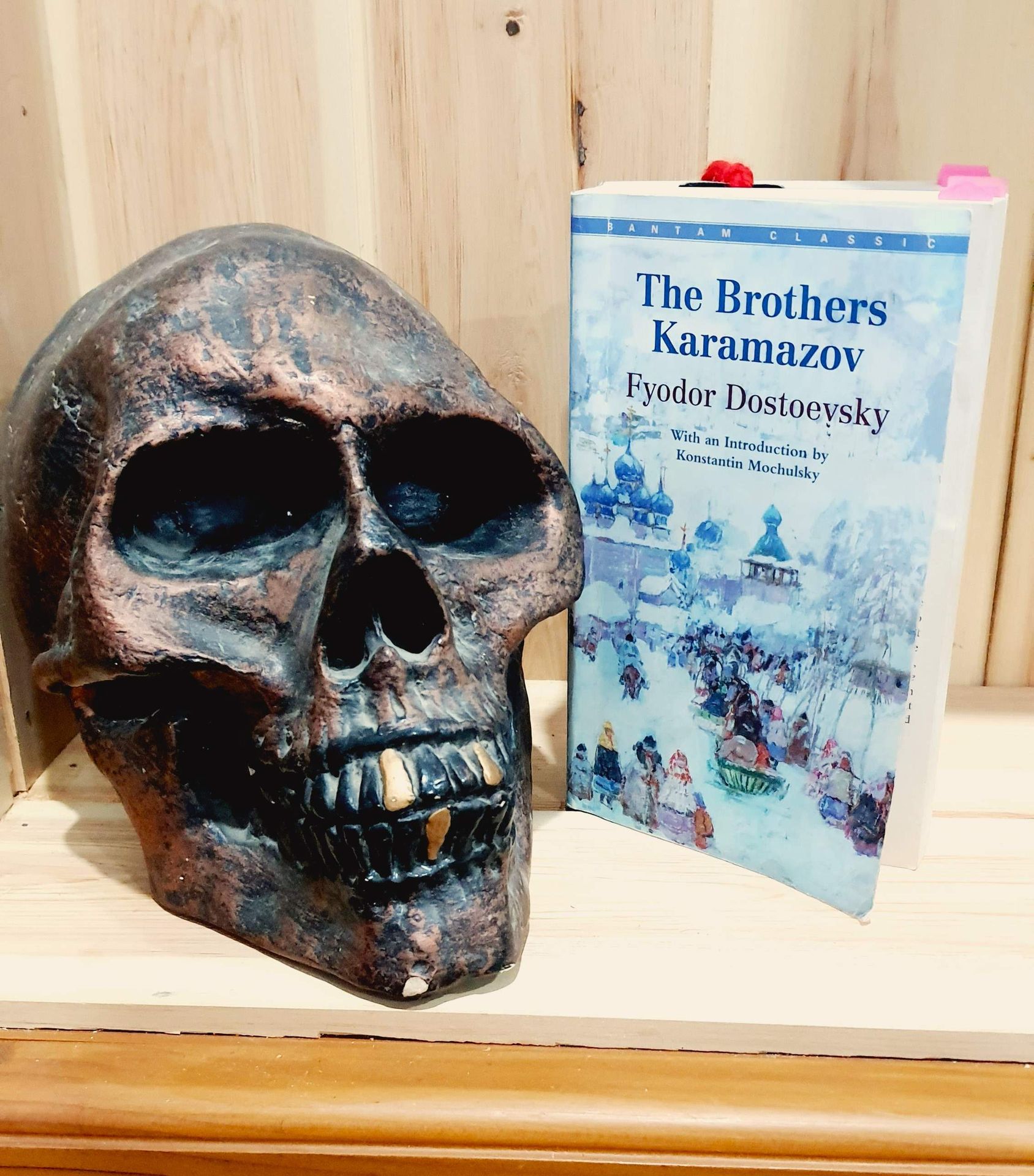
“The Brothers Karamazov” is the magnum opus of the literary career of the 19th century Russian author, Fyodor Dostoevsky. His writings are dense, dark and explore many themes of existentialism. In this novel, his work is astounding regarding the psychological insights that have been delivered in the form of a murder mystery.
The story introduces us to the depraved character of Fyodor Karamazov who is a stingy father of four sons; Dmitry, the passionate sensualist, Ivan the rational intellectual, Alyosha the spiritual mystic and Smerdyakov, the cunning trickster. The family is dysfunctional and rivalry ensues between father and eldest son Dmitry as both compete for the love of the bewitching seductress Grushenka. All hell breaks loose, as passions escalate and a murder is committed. The courtroom drama in the second part of the novel is a masterclass on psychological criminal profiling.
Presented to the reader as a sordid murder mystery, this novel contains detailed passages on philosophy. The questions of human existence, creation of the world, wickedness of human nature and morality have all been explored. As Ivan the thinker suggests his theory, he rationalizes, “If there is no God, then everything is permitted.” The conversations Ivan has with “the devil” in his states of delirium probe into the anguish of the human mind searching for truth and meaning in a seemingly incoherent debate.
One of the most remarkable aspects of the descriptive writing by Dostoevsky is his portrayal of the characters as living, breathing human beings with many contradictions. He exposes the reality that people are not good or bad, they do things that are good or bad. Hence, the judgement cannot be passed with absolute certainty.
This is anything but light reading. The death of a revered holy man and the putrefaction of his corpse causes his fellow monks to doubt his spiritual status. It reveals the superstitious lowliness and gleeful animosity of the seemingly holy figures of the monastery.
The death of the sprightly child Ilyusha, who belongs to an unfortunate family living in extreme poverty and sickness delivers a gloomy element as is characteristic of the writings of Dostoevsky. Perhaps, there are many symbols of Christian martyrdom that the author wishes to convey. Also, there is much romance and exploration of love, honor and betrayal.
“I’ve always thought that, before anything else, people should learn to love life in this world.”
“To love life more than the meaning of life?”
“Yes, that’s right. That’s the way it should be — love should come before logic, just as you said. Only then will man be able to understand the meaning of life.”